
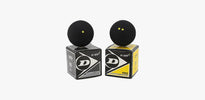
Difference between the Dunlop Pro and the Dunlop Competition Squash Ball
, by Stefaan Gehlen, 4 min reading time
, by Stefaan Gehlen, 4 min reading time
The wide range of balls in squash sometimes causes a lot of confusion and frustration. While the different squash balls are actually meant to increase your enjoyment of the game, choosing the wrong ball can quickly take the fun out of the sport. A beginner who does a little research online soon discovers that it is important to start with the Dunlop Intro Squash Ball (blue dot) and, after a while, move on to the Progress Squash Ball (red dot). But as soon as experience on court grows, players all too quickly switch to the Dunlop Pro Squash Ball (double yellow dot) and skip the Competition Squash Ball (single yellow dot). In this blog I explain why it is worth considering a ball with a single yellow dot.
In many clubs you often see people playing squash who struggle to keep a rally going, while they could be playing an exciting and enjoyable game if they chose a ball that better suits their level. The problem is not just a lack of knowledge, but also the fact that most centres sell everyone the Pro match ball, which is actually intended for advanced competitive players.
The drawback of playing with a ball above your level is that you don't yet have enough technique to warm the ball up so that it bounces properly. With a ball one level lower and a little more bounce, it becomes easier to hit the ball, it demands less of your stamina and you are able to play lively, long rallies. And that, ultimately, is the essence of the sport.
Nowadays, however, the Dunlop Pro Squash Ball is almost the standard in every squash centre, and everyone thinks they should be able to play with it. The opposite is true. The ball with the double yellow dot is designed and developed for highly advanced squash players with plenty of match experience. The Pro is the ball used by professionals in all international PSA and WSA tournaments and matches.
Until 2001 only the Competition Squash Ball existed, but as the overall level among professional players rose, a new ball – the Pro – was developed with different playing characteristics that better suit this high level. Until 2001, however, all professional World Squash Federation matches were simply played with the single yellow dot ball.
The difference between the Dunlop Pro and the Dunlop Competition Squash Ball is that the Pro has an even lower bounce. The Competition has the same dimensions as the official Pro match ball, but with 10% more bounce, which simply gives you a little more time to play the ball and makes it easier to keep a rally lively.
Unfortunately, people often forget that the temperature on court also affects how the ball plays. In colder conditions or on a court with air conditioning, it is advisable to choose a ball with a higher bounce. A squash ball is hollow and filled with air; hitting it hard against the wall warms up this air and increases the pressure, so the ball bounces better. When the ambient temperature is lower, you have to hit the ball even harder to keep it warm and achieve the same bounce. That is why highly advanced players also use the Competition Squash Ball during training and in cold conditions.
Sadly, there is little information available about the differences between the Dunlop Competition and the Pro squash ball. As a result, many people think they have to play with the double yellow dot ball, while they would enjoy the game much more with a single yellow dot ball.
If you play with someone whose level is lower than yours, choose the ball that matches their playing level.
Both the Dunlop Pro and the Dunlop Competition Squash Ball need to be warmed up to perform at their best. The quickest way to do this is to stand closer to the front wall at first, so you can hit the ball faster. If you also volley the ball, it warms up even faster. After a while you will notice the ball getting a little warmer, and you can move further back on court to warm it up further.
How long you need to warm up the ball depends on both the temperature on court and the power and technique with which you hit the ball.
An added benefit of warming up the ball is that you also do a proper warm-up yourself before you start playing, making your body less prone to injuries. You also practise all your shots while warming up.
At Squashpoint, the Pro and Competition Squash Balls are also available in a handy tube of three balls. The big advantage of a tube is that you can store the balls neatly and protected after use. This keeps them clean and easy to find in your squash bag.